

Written by Brady Holcomb, Chief Revenue Officer, RSK
For many organizations, tariff analysis begins with the customs entry. That makes sense; the entry identifies the importer, classification, value, country of origin, and duties assessed at the border.
For purposes of this article, tariff recovery refers to the process of identifying tariff-related costs that may have been passed through or otherwise absorbed by a business and evaluating whether documented discrepancies support a refund, credit, pricing adjustment, or other commercial resolution.
But a tariff’s financial impact rarely stops there. Once goods move through the supply chain, tariff-related costs can become embedded in supplier pricing, invoice surcharges, landed-cost adjustments, freight charges, purchase-order changes, and broader commercial negotiations. By the time those costs reach the buyer, tracing them back to the original customs transaction can be difficult.
That creates an important distinction for companies evaluating potential tariff recovery: customs records answer the first question (what happened at importation?), but they rarely answer the second (where did the economic cost ultimately land?).
Answering that second question requires looking beyond trade compliance and connecting information across procurement, finance, accounts payable, legal, and broader operations. Searching customs entries alone leaves the picture incomplete, while relying solely on invoices risks misattributing routine price increases to tariffs.
Tariff costs do not remain in one system
Take a typical supply chain, for example.
A supplier or distributor imports a product and pays an additional duty. Rather than showing that duty as a separate charge to the customer, the supplier adjusts its unit price. Another supplier may add a temporary tariff surcharge. A distributor may incorporate the increase into landed cost. In other cases, the adjustment may appear alongside freight, logistics, or broader market-based price increases.
From a customs perspective, the duty belongs to a specific import transaction.
From the buyer’s perspective, however, the cost may appear somewhere entirely different.
That distinction matters when companies review historical tariff exposure or evaluate whether a refund, credit, pricing adjustment, or other commercial recovery opportunity exists.
Customs records establish what happened at importation. Commercial records help show what happened to the cost afterward. Understanding potential tariff cost recovery requires connecting the two.
Start by separating customs status from economic burden
One of the most useful questions in a tariff recovery review is also one of the simplest:
Who paid the duty, and who ultimately bore the cost?
Those may be the same organization, but they do not have to be.
The Importer of Record (IOR) may control a customs filing and appear throughout the entry documentation. A different party may have absorbed some or all of the associated cost through its commercial relationship with that importer or another intermediary.
That does not mean every downstream cost supports a recovery claim. It means the analysis should distinguish among the customs transaction, the duty payment, the subsequent commercial transactions, and the economic burden.
Doing that well requires records that often sit with different functions and were created for entirely different purposes.
Trade compliance sees the entry. Procurement sees the relationship.
No single function has a complete view of tariff-related cost exposure.
Trade compliance may understand the import transaction, but it may not see how the resulting cost was incorporated into supplier pricing. Procurement may understand the supplier relationship, but it may not see the customs treatment behind a price change. Finance may see the payment, while legal may hold the terms that determine how to handle that charge.
That division of information is what makes tariff cost recovery inherently cross-functional.
A coordinated review brings together:
- Trade compliance: customs entries, classifications, origin, duty treatment, and broker records.
- Procurement and supply chain: supplier relationships, sourcing arrangements, pricing changes, purchase orders, and commercial communications.
- Finance and accounts payable: invoices, payments, credits, rebates, offsets, and financial records.
- Legal: contracts, amendments, pricing provisions, audit rights, notice requirements, and dispute procedures.
- Business leadership: supplier criticality, commercial priorities, decision authority, and risk tolerance.
The purpose is not to create another internal committee. It is to make sure decisions are based on the full commercial and operational picture rather than the view available to any one department.
Reconstruct the cost path before drawing conclusions
Finding a price increase or surcharge is not the same as establishing that a tariff-related cost was passed through.
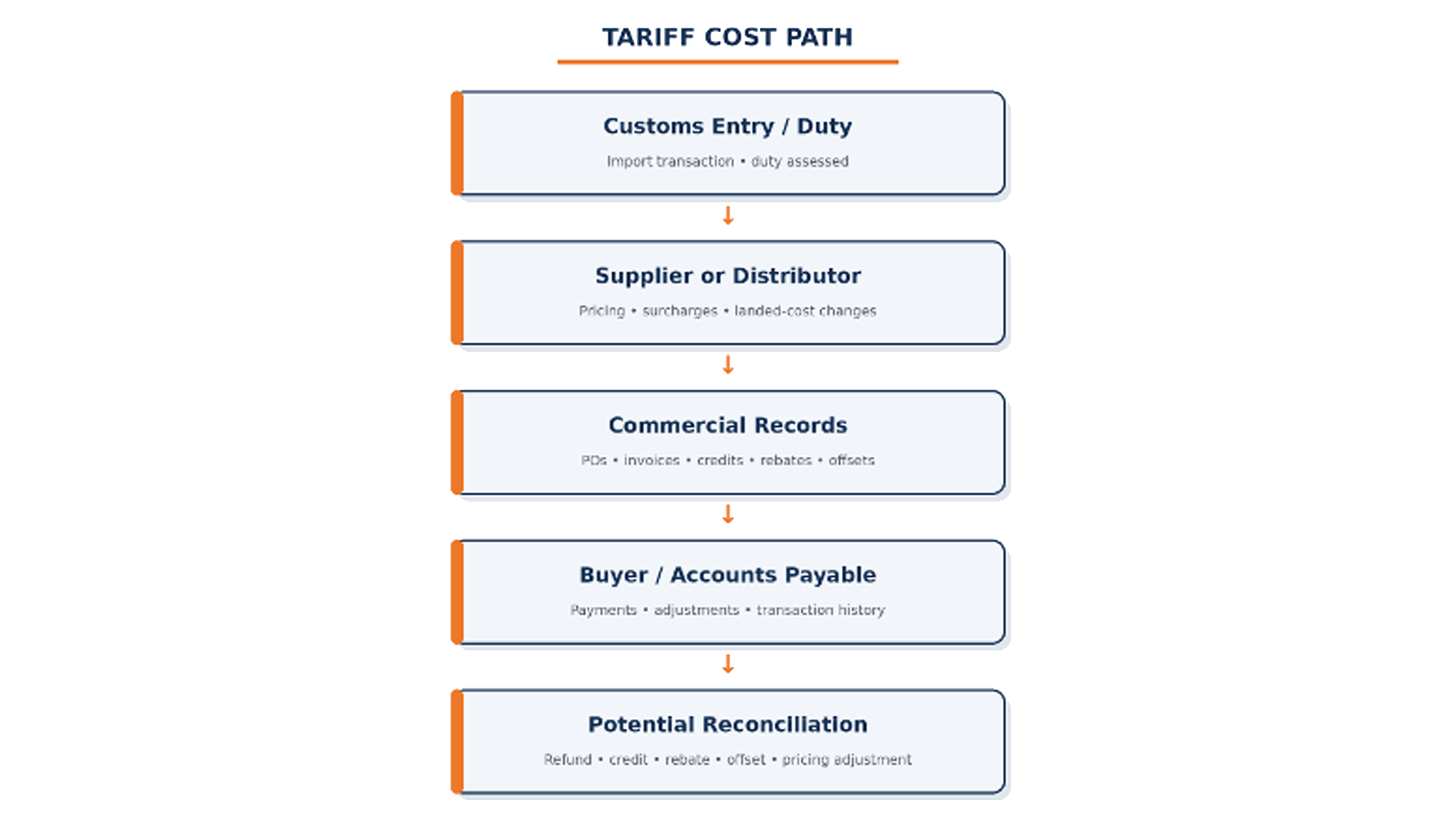
A stronger approach is to reconstruct how the cost moved through the commercial relationship. What was the supplier charging before the tariff event? Did pricing increase, a surcharge appear, or landed cost change? Was there a contemporaneous explanation connecting that adjustment to tariffs or import costs?
Then look at what happened afterward. Was the adjustment temporary or incorporated into the unit price? Did the supplier later change pricing, issue credits, or provide another commercial adjustment? Did the amounts ultimately paid align with the supplier’s communications and the applicable commercial terms?
Consider a manufacturer that purchases components from a U.S. distributor rather than importing them directly. The distributor adds a temporary tariff surcharge and later notifies customers that it will end on a specified date. Procurement locates both notices, while accounts payable finds that the surcharge continued on several invoices after that date. Finance identifies a partial credit but confirms that it did not fully offset those charges. Legal reviews the applicable pricing and adjustment terms.
Together, those records give the company a defined issue to evaluate with the supplier: whether the remaining charges should be reconciled through an additional credit or another commercial adjustment. The potential recovery issue is the documented, unresolved discrepancy—not the existence of a tariff surcharge alone.
That distinction matters. A price increase that happens during a period of higher tariffs does not necessarily represent a tariff pass-through. Reconstructing the cost path helps separate timing or correlation from an identifiable commercial discrepancy and determine whether the evidence warrants further review.
Recovery also requires governance
Identifying a potential financial discrepancy is only the beginning.
Before contacting a supplier or taking another recovery action, companies should also consider who owns the decision, what documentation supports the position, how the supplier relationship could be affected, and what forms of resolution are acceptable.
That matters because recovery does not always mean receiving a check.
Depending on the circumstances, a commercial resolution could involve a credit, rebate, offset, future pricing adjustment, contract amendment, or another negotiated outcome. Each may involve different stakeholders and different accounting, operational, and contractual considerations.
Supplier sensitivity matters as well. A transactional vendor and a sole-source strategic supplier should not necessarily be approached in the same way. Procurement and supply-chain leaders may need to weigh potential recovery against continuity, negotiating leverage, sourcing constraints, and the broader commercial relationship.
A cross-functional process allows those considerations to be addressed before outreach begins rather than after a dispute emerges.
Watch for overlapping recovery efforts
Another reason to coordinate internally is that tariff recovery activities can develop in parallel.
Trade compliance may be reviewing customs entries. Procurement may already be discussing pricing with a supplier. Finance may be processing a credit. Legal may be evaluating contract language. A business unit may have negotiated a prospective price concession without realizing another team is reviewing the same historical charges.
Without a common view, organizations can create duplicate demands, inconsistent communications, unsupported assumptions, or confusion over how a recovery should be recorded.
A coordinated approach helps the company understand what has already been pursued, what remains unresolved, and who has authority to take the next action.
Start with one supplier or category
A cross-functional tariff recovery review does not need to begin with every import, supplier, contract, and invoice across the organization.
Start with one supplier, product category, business unit, or period where tariff-related cost exposure appears meaningful. Identify the customs and commercial records connected to that activity, determine which internal teams hold them, and reconstruct how the cost moved through the relationship.
Then ask a more focused set of questions: Is there a documented discrepancy? Are important records missing? Do the commercial terms support further review? Have you already received any credit or adjustment? And which stakeholders would need to approve the next step?
That exercise can reveal both whether the individual issue warrants further action and whether the organization has the information, ownership, and governance needed to evaluate similar opportunities consistently.
Tariff cost recovery may begin with a customs event, but the financial story can extend well beyond the entry. Connecting the records and people involved gives organizations a more complete basis for deciding where further recovery work is, and is not, warranted.
About the Author
Brady Holcomb is Chief Revenue Officer at RSK, where he focuses on growth, strategic partnerships, and helping organizations identify and pursue complex recovery opportunities. With more than 20 years of experience helping organizations accelerate growth, he works closely with business leaders on tariff and supplier recovery strategies, including opportunities that extend beyond direct customs refunds. Learn more about RSK’s tariff and supplier recovery services at rsk.com.