
United States-Mexico-Canada Agreement (USMCA)
Where AAEI Stands
For over a century, the American Association of Exporters and Importers has represented the businesses that move American goods across borders, and few issues test that mission more directly than the future of the USMCA. As the agreement moves through its first mandatory joint review, AAEI’s position is straightforward: USMCA’s fundamental structure has given American manufacturers real flexibility to build integrated production across the U.S., Mexico, and Canada, and that structure ought to be preserved.
Latest Updates
July 23, 2026
Ambassador Greer, Mexican Secretary of Economy Marcelo Ebrard, and President Claudia Sheinbaum of Mexico concluded the third bilateral negotiating round in Mexico City, covering economic security, labor, agriculture, electronic payment services, steel/aluminum, and automobiles; a fourth round is set for Washington, D.C. in September 2026.
Canada’s First Ministers met in Charlottetown, PEI, and reaffirmed a coordinated “Team Canada” approach to the ongoing U.S. trade dispute, alongside discussions on energy and internal trade.
July 21, 2026
Prime Minister Carney briefed provincial and territorial premiers virtually on the state of U.S.-Canada trade tensions ahead of the in-person First Ministers’ meeting.
July 20, 2026
The U.S. proclaimed an additional 50% tariff on a range of Canadian goods under Section 338 of the Tariff Act, citing Canada’s tariff treatment of U.S. motor vehicles; effective August 19, 2026.
Prime Minister Carney responded to the announced U.S. tariffs, stating Canada has submitted proposals to resolve the dispute and modernize CUSMA/USMCA and remains ready to accelerate talks.
July 17, 2026
USTR announced the U.S. and Mexico would convene July 21–23 in Mexico City for a third round of bilateral negotiations tied to the USMCA joint review, covering steel/aluminum, autos, economic security, labor, agriculture, and electronic payments.
July 2, 2026
Agricultural, manufacturing, and business groups, along with members of Congress from both parties, issued statements on the administration’s decision not to renew USMCA in its current form.
July 1, 2026
Ambassador Greer announced that following the mandatory joint review, the U.S. did not agree to renew USMCA in its current form; the agreement remains in force pending resolution of outstanding issues.
USMCA, by the numbers
Trillion (USD)
in Annual Bilateral Trade
Million Jobs
Supported by U.S. Trade
Billion (USD)
Invested in the U.S.
Background
The United States-Mexico-Canada Agreement (USMCA) took effect in July 2020, following the signing of the agreement in November 2018, replacing the 1994 North American Free Trade Agreement (NAFTA). The development and eventual enactment of USMCA corrected previous criticisms of NAFTA, namely the strengthening of labor laws, new rules of origin (most notably within the motor vehicle industry), increased intellectual property protections, provisions for digital trade, and revision to dispute settlement procedures.
In contrast to NAFTA, the USMCA contains sunset provisions allowing for potential amendments and improvements following joint reviews every six years. In the event of one party refusing renewal, all nations are required to meet on an annual basis for 10 years to prevent termination and resolve any grievances. If an agreement is not reached within the 10 year span, the USMCA expires.
At present, the agreement is in review, with Mexico and Canada agreeing to renewal and the United States declining. The review process will continue annually until the parties agree to renewal or the agreement automatically expires in 2036. During this period of review, the agreement remains fully in force.
AAEI believes preserving and strengthening the USMCA is vital to sustaining economic growth, manufacturing resilience, and North America’s global competitiveness. Ending the USMCA would introduce uncertainty, raise costs for producers and consumers, and weaken the continent’s position in the global marketplace. AAEI supports a thoughtful review of the agreement’s challenges and believes that addressing them will further enhance its effectiveness in promoting regional trade and prosperity.
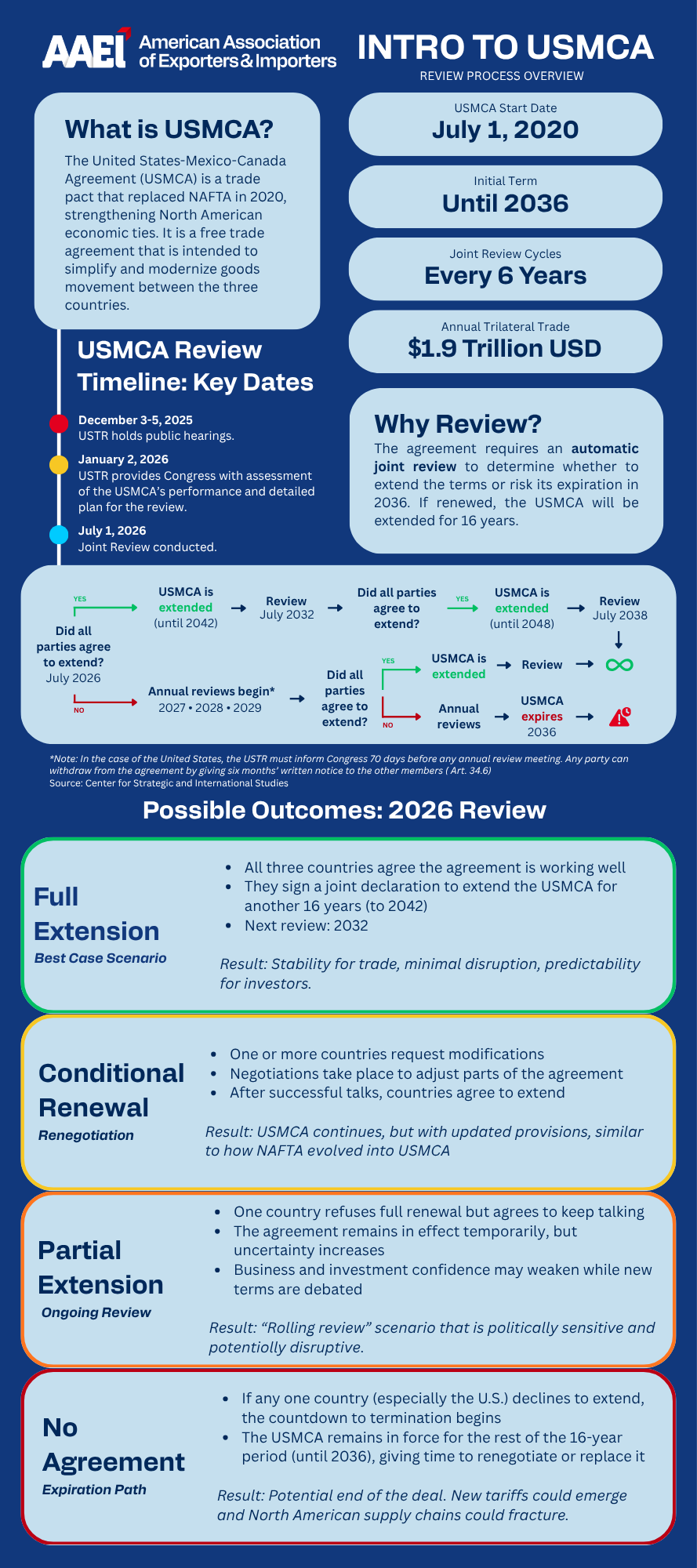
Click to enlarge.
Resources
AAEI Webinars
- USMCA in 2026: What Industries Need to Know Ahead of the Review
- USMCA & Automotive Trade in 2026: Rules of Origin, Tariffs, and Enforcement
- USMCA: Are Your Footwear & Apparel Imports Aligned?
U.S. Senate Committee on Finance
- February 12, 2026, Full Committee Hearing: The U.S.-Mexico-Canada Agreement: Evaluating North American Competitiveness
U.S. House Committee on Ways and Means
Business Roundtable
AAEI keeps members up to date on the latest updates and how they may affect your company.
This timeline is updated periodically to reflect the latest changes in tariffs and trade policies. Check back regularly for new announcements and policy shifts.